|

Lighthouses of the Carolinas: A Short History and Guide
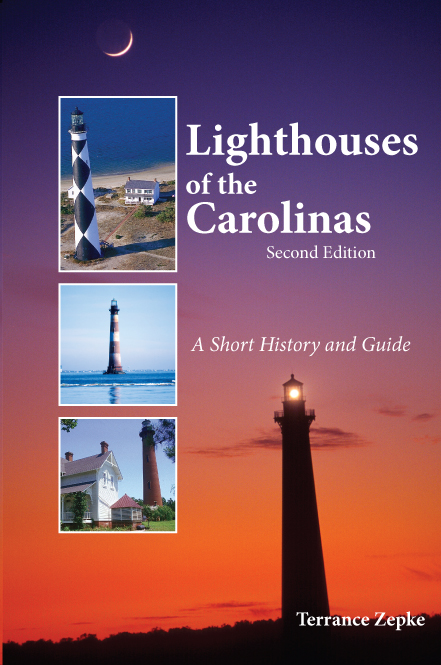
Author Terrance Zepke has collected stories of how lighthouses were built in the 1700s and 1800s, how light keepers lived, and how lighthouses have weathered hurricanes, erosion, and neglect. Traveling from North Carolina’s Currituck Lighthouse near the Virginia border to South Carolina’s Haig Point Lighthouse near the border of Georgia, Zepke weaves tales of light tower builders, Civil War soldiers, and even pirates.
Today, eighteen of these majestic towers still stand. Some have been renovated-complete with period furnishings-and are open to visitors. Others have nearly succumbed to the the sea, encroaching vegetation, and time. All are visible from some vantage point along the coast or on a passing boat, and all are close to historic towns with museums, festivals, inns, and wildlife refuges. Discover history, nature, and legend in the book and in your own wanderings to the lighthouses of the Carolinas.
Here are some interesting facts from Lighthouses of the Carolinas:
- The first of Haig Point Lighthouse’s three keepers earned $560 a year. The assistant keeper, his wife, earned $400 a year.
- Ocracoke Island, home to the second oldest lighthouse in the U.S. still in continuous service, is believed to be the site where Blackbeard the Pirate stored some of the treasure from his murderous lootings.
- Adventurers seeking a unique experience can sign on for a three-month stint as caretaker of the Cape Lookout Lighthouse.
- Morris Island Lighthouse, built in 1767 by order of King George III of England, survived until the Civil War. The replacement tower has survived a hurricane, an earthquake, and erosion.
- Cape Hatteras Lighthouse, at 198 feet high, is America’s tallest. More than one hundred years after it was rebuilt and reinforced(and moved), its foundation is as sturdy as the day it was constructed.
|
|
The book includes dozens of black and white photos, as well as eight pages of color photos. It also contains sketches, diagrams, maps, driving directions, and information on nearby points of interest.
Here are a few reviews on Lighthouses of the Carolinas:
"The book provides a detailed history of each of the structures, along with illustrations of the lights and stories associated with them or the surrounding area. Additionally, at the end of each site description is an entry for Other Points of Interest and Useful Addresses and Resources. Travelers, therefore, have a mini-guidebook at their disposal..."
-South Carolina Historical Society Review
“Zepke’s Lighthouses of the Carolinas is a handy guide to Carolinas’ beacons...”
-News & Record (Greensboro, NC)
BarnesandNoble.com
Reader Reviews -
A reviewer, a frequent traveler living in SC, February 19, 1999, Great information for travel or personal interest
"This is a well written book about lighthouses along the southeastern coast. The guide is very comprehensive with wonderful visuals-both current and archival. I found myself learning a great deal without realizing it. The fact are presented almost in a story-telling manner making it both entertaining and informative."
A reviewer, December 18, 1998, The book is a great guide to Carolinas beacons.
"I have really enjoyed this book. It explores all of the lighthouses that still exist in the Carolinas and shows how they currently look through color and black and white images. The guide also reveals lots of historical images of previous lighthouses, including keepers and their families. The book also gives directions to the lighthouses and to other nearby points of interests. I especially like the little stories that accompany the text, like the one about the ghost of Georgetown Lighthouse."
|
 |